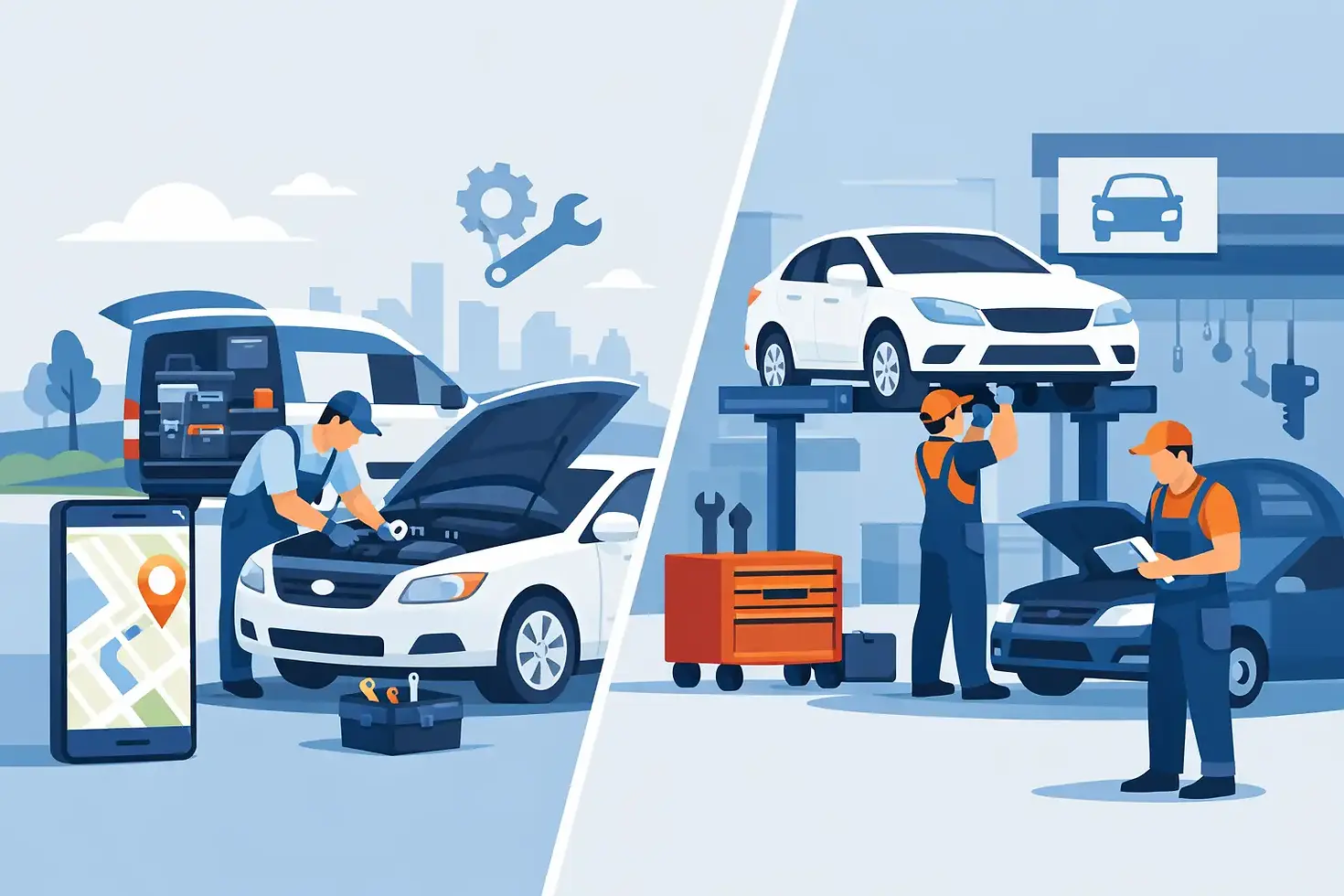
Mobile Mechanic vs Repair Shop: Which Wins?

Your brakes start grinding on a Wednesday morning, and now you have two problems - the repair itself and everything that repair does to your schedule. That is where the mobile mechanic vs repair shop decision gets real. For most drivers, it is not just about who can fix the car. It is about who can fix it without turning the whole day into a mess.
If you are weighing your options, the honest answer is simple: neither one is better in every situation. It depends on the repair, the condition of the vehicle, and how much time you can afford to lose. Some jobs make perfect sense for mobile service. Others still belong in a traditional shop bay. The key is knowing the difference before you book.
Mobile mechanic vs repair shop: the real difference
A repair shop asks you to bring the vehicle to them. A mobile mechanic brings the service to you. That sounds obvious, but it changes the entire experience.
With a repair shop, you are usually planning around traffic, drop-off times, ride arrangements, waiting rooms, and sometimes a vehicle that is not safe to drive. If the issue is brake-related, that matters. Driving across town on worn pads, warped rotors, or a soft brake pedal is not just inconvenient. It can be risky.
With a mobile mechanic, the repair happens at your home, office, or another approved location. No towing if the job can be done on-site. No sitting in line behind other vehicles. No rearranging the whole day to make one repair happen. For busy Atlanta drivers, that convenience is often the biggest advantage.
Still, convenience should not be the only factor. The better question is whether the service model matches the work your vehicle actually needs.
When a mobile mechanic makes more sense
Mobile service is strongest when the repair is straightforward, common, and does not require a full shop setup. Brake pad replacement, rotor service, brake inspections, brake fluid flushes, oil changes, spark plug replacement, and air filter changes are all examples of work that can often be handled efficiently on-site.
This is especially useful when your car is technically drivable but you would rather not push it, or when it is unsafe to drive at all. A squealing brake system may be an early warning. A grinding one usually means you waited too long. In either case, having a technician come to you can save time and reduce risk.
Mobile service also works well for people whose schedules are already full. If you are commuting, working from home, managing kids, driving for rideshare, or running a small business with vehicles on the road, losing half a day at a shop is expensive in ways that do not always show up on the invoice.
Fleet owners feel this even more. A van sitting in a shop parking lot is not making deliveries. A service vehicle waiting in line is not helping a customer. On-site maintenance can keep more vehicles available with less disruption.
When a repair shop is the better call
Some repairs belong in a shop, and any honest provider should say that upfront. If the vehicle needs a lift for major undercar work, advanced diagnostics tied to multiple systems, alignment, tire mounting, engine teardown, transmission repair, body work, or work that depends on heavy fixed equipment, a traditional shop has the advantage.
Shops also make sense when the problem is still unclear and may involve several systems at once. For example, if a driver thinks the brakes are the issue but the real problem turns out to be suspension, wheel bearing failure, or a hydraulic issue that needs more extensive testing, a shop may be the more efficient path.
That does not mean mobile service lacks diagnostic value. It means the right repair environment matters. A good mobile mechanic knows what can be handled on-site and what should be referred out instead of forcing a bad fit.
Cost is not just the posted price
A lot of people assume a mobile mechanic always costs more because the technician is coming to them. Sometimes that is true. Sometimes it is not. What matters is the full cost, not just the line item for labor.
At a repair shop, your total cost may include towing, rideshare trips, missed work time, childcare adjustments, or hours spent waiting. If the shop upsells heavily or gives vague estimates that change later, the cheapest advertised price stops looking cheap pretty fast.
A mobile mechanic may charge based on convenience and travel, but the overall value can still be better if the pricing is clear and the repair is done where the vehicle already sits. For brake work especially, transparency matters. Drivers want to know what is being replaced, why it is needed, what parts are being used, and whether the work is backed by a warranty.
That is where specialization helps. A provider focused on brake service is usually better positioned to explain the job clearly and keep the process efficient, instead of treating it like one more ticket moving through a crowded shop schedule.
Speed depends on the type of repair
People often ask which option is faster. For many common services, mobile wins. There is no check-in line, no shuttle coordination, and no waiting for an open bay after you arrive. The technician shows up with the tools and parts needed for the scheduled job.
But speed is not universal. If your vehicle needs major repairs, a shop with multiple bays, specialty tools, and support staff may move faster. The same is true if parts availability is uncertain or the repair may expand once the vehicle is inspected more deeply.
For brake service, mobile repair is often a strong fit because the work is focused, common, and urgent. Drivers usually do not want to wait days to deal with noise, vibration, reduced stopping power, or warning signs that the system is wearing out.
Trust matters more than format
The biggest mistake is choosing based only on mobile versus shop. The better way to choose is by asking whether the provider is clear, qualified, and honest about scope.
A reliable mechanic should tell you what they found, what needs immediate attention, and what can wait. They should explain the parts being used in plain language. They should be able to tell you what the warranty covers. And they should not dodge basic questions about pricing.
This applies whether the service happens in your driveway or inside a shop bay. Convenience is valuable, but trust is what keeps a repair from becoming a repeat problem.
For brake work, details matter. Pad quality matters. Rotor condition matters. Fluid condition matters. If a company is vague about those basics, that is a red flag. If they are clear about ceramic brake pads, warranty coverage, and what the job includes, that is a better sign you are dealing with a service model built around consistency, not guesswork.
Mobile mechanic vs repair shop for brake service
If your main issue is brakes, the mobile mechanic vs repair shop choice usually comes down to this: do you need specialized brake service done quickly and conveniently, or do you need a broader repair environment because the problem may be bigger than brakes alone?
When the need is brake diagnosis, pad replacement, rotor replacement, brake maintenance, or a brake fluid flush, mobile service can be the practical answer. No waiting. No towing. No hassle. You get the work done where the car already is, and you avoid driving a vehicle that may not be safe.
When the brake complaint is tied to a more complex issue, like major suspension damage or a hard-to-pinpoint system failure, a shop may still be the right next step. That is not a weakness in mobile service. It is just the reality of matching the repair to the setup.
For Atlanta drivers, there is also the traffic factor. Taking a car across Metro Atlanta for service is not a small errand. It can easily become the most frustrating part of the repair. That is why mobile brake service has become such a practical option for busy households and working fleets. Brakes Stop & Go is built around that reality - focused brake work, done on-site, with clear pricing and warranty-backed service.
So which one should you choose?
Choose a mobile mechanic when the repair is well-suited for on-site service, your schedule is tight, or the vehicle should not be driven farther than necessary. Choose a repair shop when the job requires heavy equipment, deeper system testing, or repairs outside the practical limits of mobile work.
Most of the time, the right choice is the one that solves the problem safely, clearly, and with the least disruption to your day. If your brakes are telling you something, do not spend another week debating where to go while the problem gets worse. The best repair option is the one that gets your vehicle handled correctly before a small issue becomes an expensive one.


Comments