Dealer Brake Service vs Mobile: What Wins?

Your brake warning signs rarely show up at a convenient time. They start on a workday morning, before school drop-off, or right when your calendar is already full. That is exactly why dealer brake service vs mobile is not just a pricing question. It is a time question, a hassle question, and sometimes a safety question too.
If you are deciding where to get brake work done, the right choice depends on your vehicle, the kind of repair you need, and how much downtime you can tolerate. A dealership has some clear advantages. So does mobile brake service. The difference is knowing which one matters more for your situation.
Dealer brake service vs mobile: the real difference
At a basic level, both options can inspect and repair braking components like pads, rotors, calipers, and brake fluid. The real difference is how the service is delivered and what you pay for around the repair itself.
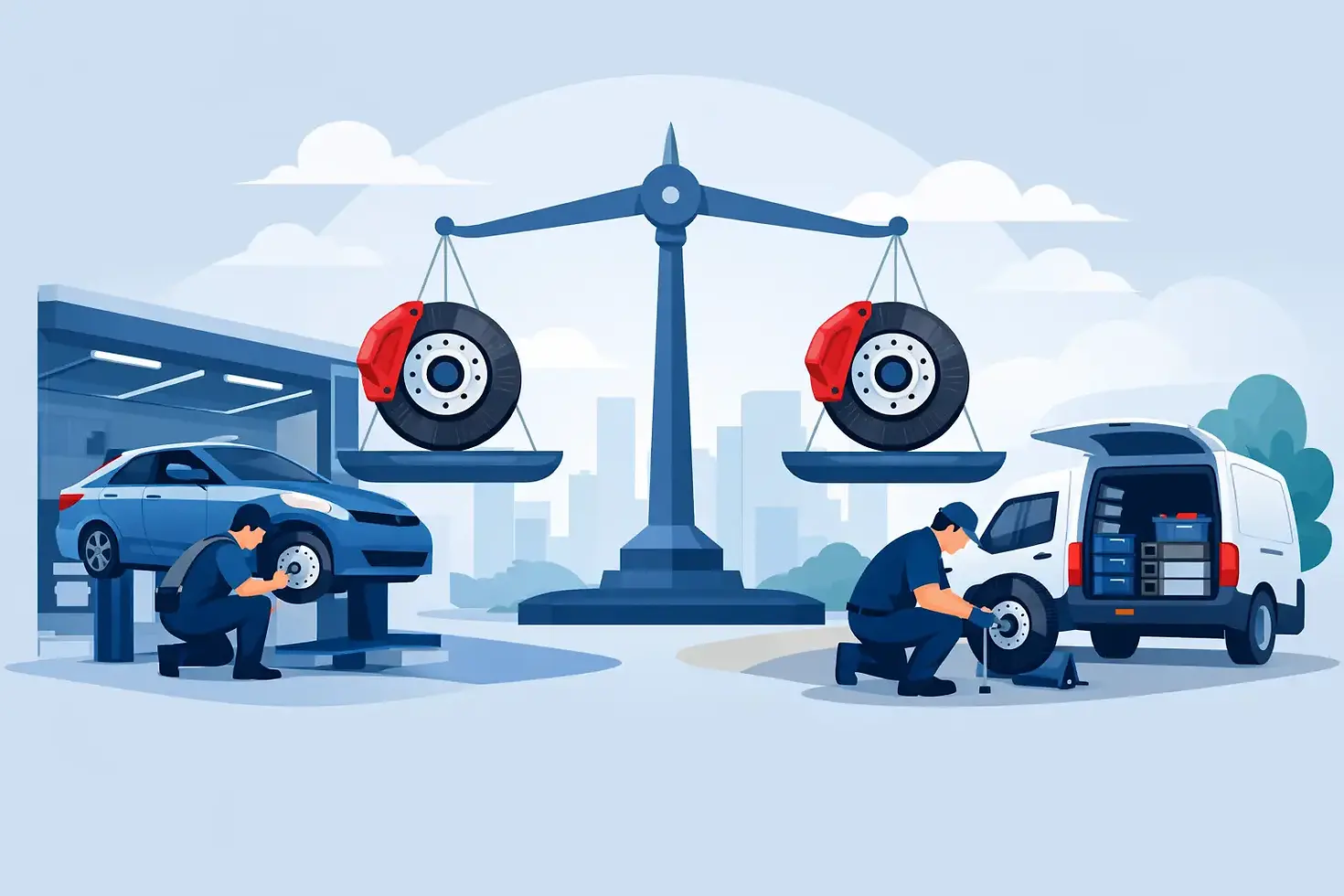
Dealer service happens at the dealership, inside a larger operation built to support one vehicle brand or group of brands. You drive there, wait there, arrange a ride, or leave the vehicle behind for part of the day. Mobile brake service brings the technician to your home, office, or fleet yard and completes the work on site.
For many drivers, the brake repair itself is only half the issue. The bigger frustration is the disruption. Taking time off work, sitting in a waiting room, arranging transportation, or paying for a tow can make a straightforward brake job feel much bigger than it should.
That is where mobile service stands out. No waiting. No towing. No extra trip across town just to solve a brake problem.
When a dealership makes sense
There are cases where the dealership is the right call. If your vehicle is still under a factory warranty and the brake issue may be tied to a covered defect, the dealer may be the best starting point. The same goes for recall-related brake work or highly brand-specific software diagnostics tied into advanced electronic systems.
Dealerships also make sense for drivers who prefer all service records to stay under one roof, especially for newer luxury vehicles. Some owners simply feel more comfortable having brand-trained technicians handle every repair. That preference is understandable.
There is also a parts argument. Dealerships usually stock or order original equipment manufacturer parts for the brands they sell. If you want factory-specific replacement parts for every component, that may matter to you.
But even in those situations, it is worth asking whether the issue truly requires a dealer. Many brake jobs do not. Pads, rotors, fluid flushes, and common brake repairs are often routine work that an experienced mobile brake specialist can complete without the dealership markup or the lost time.
Where mobile brake service has the advantage
Mobile brake service is built for people who need the repair done without rearranging their day. That includes commuters, parents, rideshare drivers, and business owners who cannot afford to have a vehicle parked at a shop all afternoon.
Convenience is the obvious benefit, but it is not the only one. Mobile service can also be more transparent. You usually speak directly with the technician or service provider handling the job. You get a clearer explanation of what is wrong, what needs to be replaced, and what can wait.
There is less overhead built into the service model too. A mobile brake company is not carrying the same dealership facility costs, showroom costs, and staffing layers. That often leads to more competitive pricing for the same category of work.
For fleet operators, the gap gets even wider. Pulling multiple vehicles out of service and sending them to a dealership can create unnecessary downtime. On-site brake service keeps vehicles closer to the route, the office, or the job site.
Cost: where dealer and mobile pricing usually split
If you compare dealer brake service vs mobile, price is one of the first things people ask about, and for good reason. Dealership brake work is often more expensive. That does not always mean the work is better. It usually means the operating model costs more.
At a dealership, you may be paying for factory branding, larger facilities, service advisors, and a longer process between drop-off and repair. You may also see higher labor rates and parts pricing.
Mobile service can often reduce those costs while still using quality components. That matters because brake work should be judged by the quality of parts, the accuracy of the diagnosis, and the skill of the technician, not by how expensive the waiting room looks.
That said, cheaper is not always better either. If a mobile provider gives you a low number but uses low-grade parts or avoids warranty coverage, the savings may not last. Good brake service should come with clear pricing, quality components, and real warranty support.
Speed and downtime matter more than most drivers expect
A brake problem tends to feel urgent because it is urgent. Grinding, squealing, vibration, soft pedal feel, or reduced stopping performance should not sit on your to-do list for long.
This is where mobile service often wins in practical terms. The issue is not just how fast the wrench turns. It is how fast you can get from problem to appointment to completed repair.
Dealership schedules can be backed up, especially during busy periods. Even after you arrive, the vehicle may sit in line for inspection before any work starts. A mobile brake appointment is usually more direct. The technician arrives where the vehicle already is and gets to work there.
For busy households, that can be the difference between solving the problem today and putting it off another week. For business vehicles, it can mean less lost revenue.
Quality is not about the building
Some drivers assume dealership service is automatically better because it happens at a dealership. That is not a safe assumption. Good brake work depends on the technician, the inspection process, and the parts installed.
A specialized mobile brake provider may actually perform brake work more often than a general dealership technician who handles a wide range of repairs. Repetition matters. Focus matters.
That is especially true with common brake services like pad replacement, rotor replacement, caliper service, and brake fluid flushes. These jobs reward experience, proper diagnosis, and attention to wear patterns. They do not require a giant facility to be done correctly.
For example, a mobile brake company like Brakes Stop & Go is built around brake-specific service, not general dealership volume. That kind of focus can be a real advantage when you want straightforward answers and efficient repairs.
What to ask before choosing either option
Whether you go with a dealership or a mobile provider, ask a few direct questions before booking. Are the parts high quality? Is there a warranty? What exactly is included in the quoted price? Is the recommendation based on inspection, or are they pushing a standard package?
You should also ask whether the issue involves something outside routine brake service. If your car has a recall, a factory warranty concern, or a deeper electronic brake system issue tied to manufacturer programming, the dealership may be the right fit.
If the repair is a typical wear-and-tear brake job, mobile service is often the simpler option with fewer disruptions and lower total hassle.
Dealer brake service vs mobile for different drivers
The best option often depends on how you use your vehicle.
If you drive a newer vehicle under factory coverage and you want all work documented through the dealer network, dealer service may be worth the extra cost and time.
If you are a busy commuter, a parent managing a tight schedule, or a driver who cannot sit in a waiting room for half a day, mobile service usually makes more sense.
If you drive for rideshare or delivery work, downtime is money. Mobile service can protect your schedule better than a traditional shop visit.
If you manage a small fleet, mobile brake service is often the practical choice because it reduces disruptions across multiple vehicles, not just one.
The better choice is the one that removes friction
Brake service should solve a safety problem, not create a scheduling problem. That is why the decision between dealer and mobile is about more than credentials or price alone. It is about how quickly, clearly, and reliably the repair gets handled.
For routine brake repairs, mobile service often gives drivers the better overall value. You save time, avoid towing and waiting rooms, and still get professional brake work done where your vehicle already sits. For recall work, warranty issues, or highly manufacturer-specific concerns, the dealership may still be the right move.
The smart choice is the one that fits the repair and your real life. If your brakes need attention now, do not just ask who can fix them. Ask who can fix them with the least hassle and the most confidence.


Comments